Thursday, 17 May 2018

Is ‘niceness’ a leadership quality?


I’ve been contemplating the nature of leadership after the death of Tessa Jowell.  In the first comments when it was announced, what came over was her ‘niceness’.  ‘She got on with everybody’ was a common phrase, ‘a gem’, ‘a great person’, ‘her likeable personality’, she ‘exuded cheerfulness and gave even those she had only just met the sense of being one of her old friends’.

 Further reading demonstrated that she was an exceptional leader: respected by all regardless of politics, class or ethnicity and she got things done. It seemed that no matter the complexity of the issue, or the political sensitivity it generated, she was the person who could deal with it.

She had the tricky task of dealing with the DoH, was minister of state with responsibility for women,  minister for employment, welfare to work and equal opportunities.  Following the drive to improve standards she introduced health targets, maternity and paternity leave and Sure Start which supported and empowered young mothers. She became Culture Secretary and brought the Olympics to London, was given responsibility for looking after the victims of 9/11 and the London bombings.  She was in charge when the future of broadcasting was in the headlines and introduced Ofcom and adroitly handled the controversy of her husband’s involvement with Berlusconi.  Then of course there was her campaign for improved services for those afflicted with cancer.  

It was a record that any leader would be proud of and who can name any leader in the private sector who can say they were faced with the level of challenges she faced and dealt with them as competently?

So why did people default to her ‘niceness’ when describing her?  Could it be that, because leadership terminology is structured around male qualities of strength, determination, drive, power, they did not have the language to describe her undoubted leadership qualities?  That by her being female it revealed people’s unconscious biases about what constitutes leadership?

Further reading revealed that people also noted her ability to ask ‘penetrating questions’, her ‘passion, determination and a sense of mission’, a ‘visionary’ who saw how things could be, a woman with ‘internal steel’.  She consummately combined those qualities with a high degree of emotional intelligence to achieve what is now being lauded throughout the country.

So yes, I would say that ‘niceness’ is a leadership quality but it’s the niceness that’s also accompanied by a sharp intellect, a commitment and belief that anything is possible and the ability to communicate that to everyone within their sphere.  Alas, there are too few leaders like her, and too few who recognise and encourage that potential within others.

Friday, 13 April 2018

Philosopher or Coach?

You're the CEO in your business or organisation, or maybe an HR Director and you've taken the decision to commission some coaching to help improve productivity and decision making.  It's a wise move as there's a many a quote from CEOs of blue chip companies that they recommend having a coach for success.  Yet those at the very top are now reaching out to philosophers it seems. 

As Prof  Marinoff, from the City College of New York says in a Guardian article,“These are very intelligent people, who are also overworked, more so than most of us. And they don’t have enough time to reflect. A lot of what we do is to create reflective space.”

It's not just in the US either.  Joe Garner, Chief Exec of Nationwide also works with a Professor of Philosophy.  As mentioned in the article, 'A philosopher can nudge and question, take leaders on uncomfortable journeys, even be a disruptive force.'

I feel that our learned Professors are now being forced to seek alternative income generating streams and are promoting a methodology that is already in use; just assimilating it, claiming it for themselves as a new way of doing things. 

So, I'm sure they can do all that they say but, and here I'm going to admit to being a bit biased as I'm a coach, isn't that what good coaching does anyway? 

Yes there's different coaching models but the positive psychology methodology that I use provides that protected, reflective space.  It enables deep seated questioning of oneself, of one's approach and values - all the things that the philosophers state they do so much better than coaches.

I also encourage the client to take those uncomfortable journeys and believe me, it's not all sweetness and light.  They do question their strategies, their decision making and scrutinise their actions.  With the positive attention they have, and knowing they're not going to be interrupted they have time to think with quality, to step outside of the boxes they might have placed themselves within and become their own creative, innovative selves as a result.

I've seen amazing changes in direction from the client who had spent three days agonising over an issue to come up with a solution in less than 30 minutes because they had that protected, positive, supported thinking space.   With my challenge I've listened as the MD questioned their own assumptions about an issue and found a completely different route, a new strategy that made a significant impact on performance.

So no, it's not philosopher v coach.  It's just another model of coaching; a model that is already being used by experienced, qualified, client centred, positive psychology coaches.  We too provide an environment where you can nudge and question, even be a disruptive force. 

So welcome Prof Marinoff - just don't try and pass this off as something new because it ain't.

Wednesday, 4 April 2018

Where is leadership in the gender pay gap debate?


So, as of midnight on 4 April 2018 companies with over 250 employees have had to report on their gender pay gap.  It’s a milestone achievement to officially recognise that there is a gender pay gap, even though there are many who swear there is no such thing.  And the vitriol from those who think it’s a feminist generated plot to undermine men’s roles in society is astounding.

What’s interesting is the breakdown displayed so far.  RyanAir report the highest GPG at 71.8%, saying that it’s because pilots are the best paid (male dominated) and women make up the majority of the lower paid roles.  Conversely certain High Street brands report no difference, whilst 8% of those who have declared so far, report they pay women more.  The GPG in reverse as it were.

There’s also a clear sector differential with the highest gap being in the construction industry, closely followed by finance and insurance.  Yes these are traditionally male dominated industries but education, which is frequently declared to be a profession that attracts more females, is running a close fourth. 

Where then is the source of the issue and thus the source of the solution?

Stereotypes reinforce sector differentials
Of course it’s more complex than just one issue and one solution.  Parents, society, education, the media all have a role to play in challenging stereotypes and the sector differentials by encouraging girls to enter STEM whilst boys can make good careers within social care.


But can they?  Can either poles be truly equal?  Not currently because society puts different values against each option with unconscious biases regarding the skills and qualities required, labelling them as either male or female.  The reality is that we can all learn the skills and qualities – it takes an effort on the part of the industries themselves to change things.   And an effort it will be if this issue is to be fully addressed.  For what’s the point in reporting it if no action is going to be taken to change?

And then we have the huge bulk of businesses who employ less than 250 people.  Are they equally cognisant of the issue?  Are they recognising and, importantly, dealing with it?  They won't be immune from the fall out as customers and employees may well start to question them on pay differentials.  Certainly if they're part of a larger supply chain in government contracts they may well have to prove their credentials on this issue. 

A moral hysteria?
There are those who think it’s a flash in the pan, the latest moral hysteria that sweeps societies periodically.  Give it six months or so and things will quieten down.  There’ll be no penalties issued for those who do not report, no backlash if things don’t improve. 

Yes, things will quieten down and yes, there will be some who do not report and some who do nothing …  BUT

I sense a paradigm shift here.  There is a new wave of feminism driving this.  Not the hawkish, demanding feminism (or so it seems to be described now) of the 60s and 70s.  No, this is a quieter, more assured, socially, societally grounded feminism that recognises true equality between men and women.   And now it’s being accepted that it’s OK in the UK to talk about pay, about what you earn.   The more it is described within the media and the boardroom, over the water cooler and the sports fields, the more women, and men, will demand it.  That demand can only be fulfilled by the industries themselves.

Leaders must embrace a new paradigm
It takes excellent leadership to redirect the habits and practices within industries, to reshape the cultures and those unconscious biases mentioned earlier.  It takes leadership to take an organisation in a new direction and deal with the flack that always comes as a result of change. 

Some leaders have already recognised this and are actively making a difference.  Do you consider yourselves to be amongst them?  Would others agree with you or would they think you’re complacent or complicit?  Do you recognise leadership within your industry or community and if so are they supported?  Or are they bashing their heads against a brick wall? 

Leaders today have a decision to make.   They will decide whether to embrace the new paradigm and get the support to do so, or they will decide to wait and see.  The ‘wait and see’ brigade may well end up the ‘wait and decline’ squad as its workforce, and customers, gravitate to those who are fessing up and actively changing.  They will be the ones who have acknowledged the under-utilisation of 50% of the population as industry differentials are challenged.  It won’t be easy – leadership was ever thus – but it can be done. 

Monday, 26 March 2018

Prof Stephen Hawkins: the ultimate thought

I’ve just spent two days completely immersed in Nancy Klein’s Thinking Environment as part of developing my own coaching/facilitation skills.  We are encouraged to BE the Thinking Environment and in the middle of it all, it came to mind that perhaps the late Prof Hawkins was THE ultimate Thinking Environment.

I didn’t know the man, I haven’t heard his lectures and, I’ll admit, I haven’t bought or read any of his books.  I’m sure, like us all, he had his good and bad points but it seems from the eulogies I’ve read that he was always supportive of other people’s thinking and any contribution he made was erudite and incisive.  Apparently he credits his disability with his ability to think as comprehensively and with such quality as he did.

Thinking about situations where we think well, or not, and Nancy’s 10 components of the TE I pondered more about Prof Hawkins.  Certainly he gave his own thinking full attention and when others were in his presence he, of necessity would give them full attention.  So often we think knowing that we are going to be interrupted at some point, or that the listener will have the urge to drop in a comment, or finish our sentences.  That lack of respect, of equality, prevents us from true quality thinking. In Prof Hawkins’ case because he would not be able to instantly interrupt, the thinker in his presence would be at ease as a result – another of the 10 components.

Certainly the quality of his thinking was generative – his theory on black holes was revolutionary and his freshest thinking, that actually he could have been wrong about energy levels within them came about because he continued to have quality thoughts.  And perhaps he asked his own incisive question whilst he was thinking to have that change of theory – something that as coaches and facilitators we know the brain can do.

What lessons can we learn from him then that we can take into our own lives and organisations?  That we do not give ourselves enough time to just think?  That thinking is more creative, more productive when we have others that can help us to think?  That we should be open to proving ourselves wrong as a means of generating new ideas, new streams of productivity and new insights into how we solve the complex issues that face us?

From my viewpoint I will think more about how I can encourage such an environment for my clients and as Prof Hawkins said, ‘In my opinion, there is no aspect of reality beyond the reach of the human mind’.

Friday, 16 March 2018

Leadership and development funding available

Would you like up to 50% funding for coaching, leadership and development support?


If you are making, producing or assembling a product of any sort, and you're an SME in Sussex or Kent, then get in touch now with Robin Simpson, Manufacturing Growth Manager by phoning 07773 228 147 or email: robin.simpson@egs.live

The opportunity has arisen because there's European funding via the Manufacturing Growth Programme to help grow manufacturing capacity and job creation in the UK - and mtc2 ltd are one of the approved providers.

We often think of manufacturing as light industry in this area but it can be so much more than that! In East Sussex and Kent we know of major manufacturers of a range of products from top notch double glazing, to pumps and precision instruments, to micro-breweries and perfumeries.  Did you know that  processing food and drink also counts as manufacturing and can be covered by the grant so let your imagination run riot.

How much can leadership and development funding can I get?

It very much depends on the size of the project you want to undertake.  

The financial support available can provide you with up to 35% (excl. VAT) of the cost of an improvement project  but for for projects demonstrating significant job/new product growth and higher level of applicant contribution you could get up to 50%.  

Types of projects covered include: Strategic Planning,  Change Management, People Development and  Leadership and Management, all of which are in our remit. 

Typical project values are between £3,000 to £5,000 (ex. VAT), with an average grant to a business of about £1,400. The minimum grant though is £1000 which equates to a minimum project total value of £2860.

The process is very quick and easy and all you need to do is to contact Robin saying you want mtc2 ltd to provide you with leadership and development support.  

Get in touch with Robin now as this offer is time limited!


Currently available in the South East to manufacturers based in East Sussex, Kent and Essex; as well as across 14 other Local Enterprise Partnership (LEP) areas manufacturers can get additional support via the programme.  If you want to know more about the overall programme then go to www.manufacturinggrowthprogramme.co.uk 


Thursday, 25 January 2018

Where does thought sit in today's business world?

According to an IoD article in the Directors magazine, a  recent study by a Swedish university on brain plasticity found that the brains of the overworked are aging more quickly.  In addition it reports, the busier CEOs become, the slower their thinking.  Clarity and creativity decreases and they might make bad decisions.  

The warnings of professionals for many years of the pressures on all top tier levels of management, and indeed of their teams, is now made real.  As stress levels rise, absence levels follow and the quality of decision making is arguably declining.  What impact is this having on organisational growth?  How do we address the threat of declining quality decision making in our leading companies and organisations?  It requires a fundamental shift in not what we do, but how we do it.

‘“What do you think?” are the four most powerful words to use in any transformation.’

So says Rene Carayol, globally renowned Executive coach and broadcaster.   The problem in most organisations is that even when (or if) they ask the question, not only is the questioner not listening with full attention, but the person asked is never given the time and space to truly think.  As a result, opportunities are lost.

Nancy Klein with Laura MurphyIn Nancy Klein’s ground breaking work on the Thinking Environment, she found that we think least well when faced with ridicule, competition, cynicism, criticism, and self-doubt.  We think best when we know we are respected, are seeking the best idea, not trying to win; our questions are welcomed, when we are encouraged to think beyond the usual.   And practical application of the tools associated with the Thinking Environment have borne exceptional results with participants universally praising the reduction of time spent in meetings, the quality outputs arising from conversations and the enhanced level of decision making at all levels of the business.  Excellence in leadership is developed at speed.

In my own work with the UK Division of a global company allowing people to think in the presence of full attention, equality and ease has generated a major shift in focus.  Senior executives are more confident about the decisions they are taking and how the actions arising from high quality thinking will occur. Running meetings using this approach and then focussing on one or two incisive questions has also enabled people to speak out with confidence. Creative solutions have been found that they readily admit would not have occurred otherwise and there is a greater clarity on what makes the difference to their bottom line.   

Partnership working is frequently a battleground with different private and public sector organisations following varying agendas and miscommunication can be rife.  It can also be a challenge to gain agreement using a vocabulary that is understood and owned by all sides.  Asking that question, “What do you think?” and then waiting, curious to know the answer and then curious to know what’s coming next is revolutionary.  No longer do people listen purely to interrupt, or add, or counter and there is no space for conflict to feed itself.  The result is better quality thinking and decision making.   
The impact is just as powerful on smaller organisations and some would argue more so.  It is their nimble flexibility which makes them a challenge to the corporates, the disruptors of their industry.  Yet SMEs have their own stressors which can threaten their ability to be nimble and with fewer resources at their disposal to help them cope.  A few simple changes to how they interact within their own staff, customers and suppliers can cut through this.  Faced with a problem, the SME senior group encapsulated it within a question and then following the principles above, enabled staff members who, the Director confided never spoke up, to bring their ideas to the table.  They cut through to the core of the problem and proposed a solution that would have remained unsaid. 

“We did this in half the time it would have taken to come up with a solution, and I think had the workshop been run differently, the solution would not have been as effective.” Business development manager

Many of us work in environments that do not encourage real thought and if this is your reality, your organisation is ignoring a sea-change in how excellent leaders operate.  A survey by Southampton University on 15 organisations that do operate in this manner quoted this:

“I can positively say that as a result of our Thinking Environment culture, our business has improved by at least 20%.  And that’s measurable in financial terms.” Provincial director, financial services

Ask yourself this incisive question. 

“If I knew that by generating a thinking environment I would improve work practices and take quality decisions, what would I do next?”


Get in touch and tell me.

Saturday, 11 November 2017

Where's mental health when it comes to Leadership?

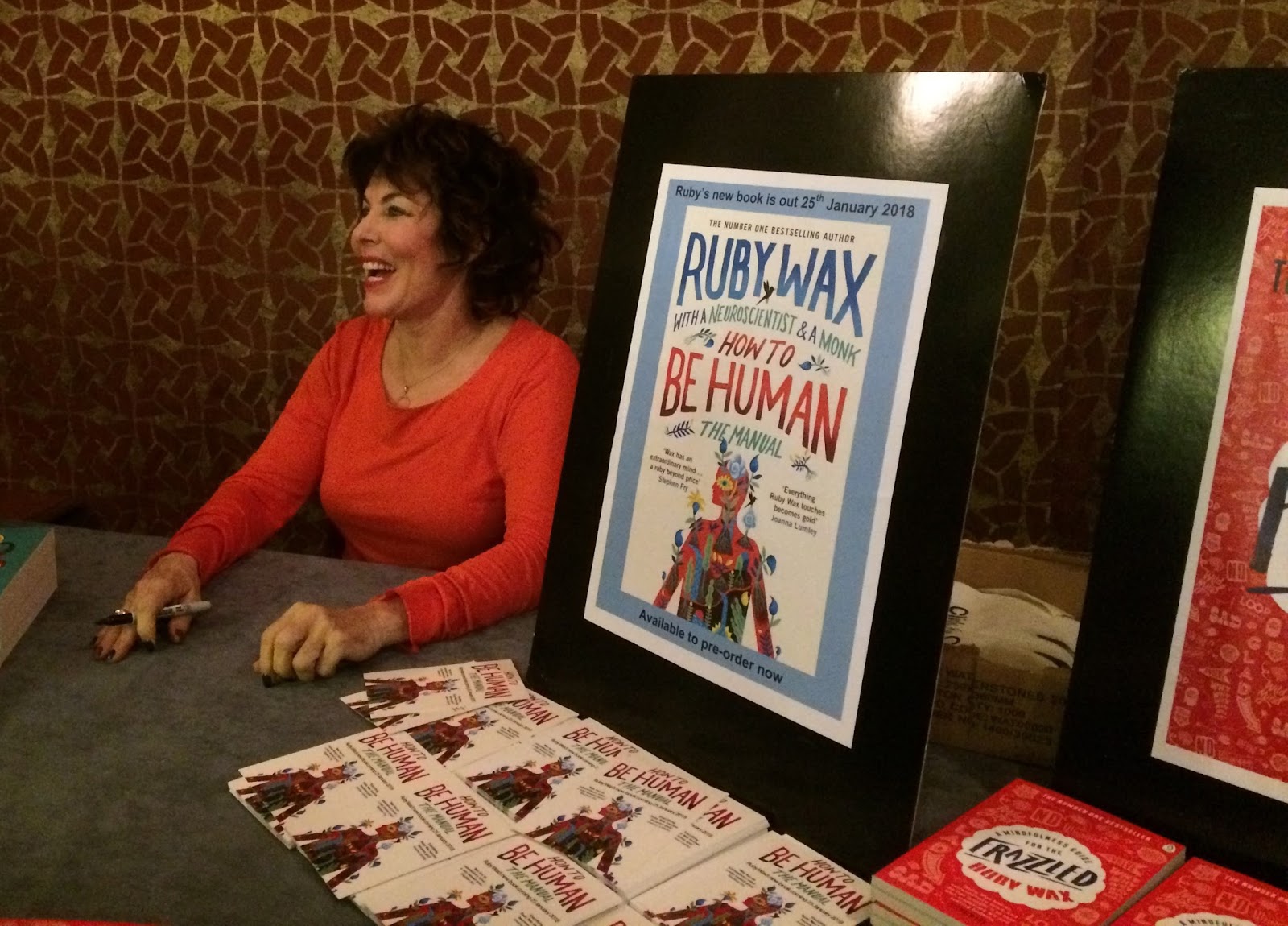
I took myself off to watch Ruby Wax at our local theatre for her Frazzled tour.  It was the first time I'd seen her 'in the flesh' so to speak.  I'd known about her through her TV comedy and that she'd had a hard time, taken herself off to do a degree and was promoting the need to acknowledge mental health issues. 

It was an insightful, honest, thoughtful, thought provoking, at times rapidly paced journey through some of her life's experiences.  Sure there was the comedy in there but there was also an extreme sense of fragility and bravura as she exposed herself to our gaze.  For those of you who haven't seen it I would recommend you do for it opens a window into how, in her case, severe mental illness can affect your life and makes you ask yourself questions.


In the second half of the show she opens herself up to questions.  Again a risky venture as you never know what will come out or how the questions might touch your inner demons.  Unfortunately I didn't get to ask the question I wanted to, despite having my hand waving in the air less than 2 metres from the woman with the roving mic.  I'm going to ask it here, right now and I'd be interested in your responses.

The question is, how do we show leadership when it comes to dealing with mental health issues in the workplace?

Monday, 20 March 2017

Swept into the techno-embrace

You've heard the stories that our devices could be used to launch a cyber attack.  Seminars on cyber attacks are a new growth industry.  This week companies such as McDonalds, M&S, BBC etc are taking their advertising away from Google and You-tube because they're being associated with terrorists or other 'unsuitable' organisations.  Is this the end of the glory age of technology?

Anecdotally some intelligence agencies are using old fashioned typewriters for their ultra-sensitive material because it can't be hacked.  I so hope that isn't an urban myth!  The reality is though that we've had two generations now who have been brought up using digital platforms and technology. Our manufacturing systems are becoming reliant on robotics, our cars are run by electronics, our supermarkets have stocks supplied using data information streams.

No, our first world is entrapped in technology, cling-filmed, vacuum packed, irradiated, and destined to be so for eternity. And the third world is coming into the age of smart phones super-fast. It won't be long before they too are swept into the techno-embrace.

It's not all bad though.  Yes there's the ever pressing issue of hacking and if you want to protect yourself change your passwords on a regular basis or use tools such as Dashlane4, 1Password, LastPass, Roboform or Keeper to make it easier).  Yes, there's the danger that your business or organisation becomes the modern version of a ship in the Bermuda triangle if your IT fails (ensure you have a robust disaster strategy in place).  Yes, demand for IT savvy employees will be huge and the salary bill will rise as supply will be short (train your own). There's positives too. The Dept for Business, Energy and Industrial Strategy reckons SMEs could save up to £8.9billion in energy costs by using smart tech.  Central government is pushing  the second round of grants available for a £15m pot of money for emerging technologies, you can get R&D tax relief if you're involved in any new development (and by the way that's not just restricted to programing).

So no, it's not the end of the glory age of technology.  Let's just say it's now moving into it's maturing stage.  There'll still be stumbles along the way such as Google's algorithms that place adverts alongside hate videos that are the antithesis of the advertiser's values.  There'll be the odd huge leap of a new product or service but generally speaking the technology revolution is now a way of life. We'll settle into the rhythm of it all, the outbursts of this month will quieten down - until the next outburst and thus runs our lives in this technological age.

Friday, 3 February 2017

Are Corporates the new Government?

You can't have failed to have noticed that there's a new PROTUS and he's 'Big in business'.  So big in fact that all of his inner circle have also been 'Big in Business'.  It appears that the socialist-light policies enacted by the previous PROTUS are being quickly dismantled so that businesses can get back to doing business.

Is this a good or a bad thing?  The headlines certainly indicate that it's anything BUT a good thing as job security, employee rights, environmental safeguards are reportedly whittled away.

Big mergers, according to Simon Caulkin writing in Professional Manager are merely an investment in political power and influence.  According to The Guardian Corporates are utilising the 'dark arts' to rule governments.  

Is this a moral panic as the hard-fought gains (according to one section of society) are being destroyed in the stroke of a pen and we return to the days of corporate greed.  I'd argue that corporate greed has always been with us and the dystopian future of businesses running the world  has come one step closer to actually being recognised as such.  The reality is that since trade began, since manufacturing transformed the world's economy, since technology revolutionised working practices, big business has always ruled.  

It's taken a small number of influential, highly regarded people, the philanthropists of the Victorian Age, the Al Gores, Warren Buffett and Bill Gates of today to hold them in check, ex-corporate heads and political high achievers with the values required to put checks and balances in place. Through dint of sheer energy or legislation they've have the chance to temper the testosterone fuelled, power hungry CEOs - and their shareholders.

Unfortunately it also only takes one person who can galvanise the energies of those who have been left behind by these revolutions, who are not equipped to take up new roles or the resources to move to different parts of their own country or further afield and that look for someone to 'make it right'. That one person with the wave behind them can similarly step in like the fox in the hen-house and enable the corporate greed to resurface again.

So what do we do about the Corporates that are blatently taking over the world?  The FSB say that SMEs are the engine of economic growth so how do we nurture them and enable them to act as a balance to the mega-companies that have so much power and influence?  Because if we don't then we might as well forget about political elections for truly the Corporates will rule the world.
 

Monday, 5 December 2016

Southern Rail: one of Baldrick's 'cunning plans.'

I had a conversation recently with a close friend who'd been trying to get a resolution to a customer complaint with a major retailer for nearly two weeks.  Phone calls and emails had all been ignored and the complaint was nowhere near resolution.  Then they sent a tweet and the tweet said:

"[company]'s customer service equals that of Southern Rail"

Within five minutes there was a response via twitter.  Before the end of the day a phone call was made by a senior member of the customer complaints team and the problem had been rectified.  When asked why they'd responded so quickly when they'd ignored my friend for two weeks, the answer was surprising.

"We don't want to be associated with Southern Rail."

Nothing to do with the immediacy of twitter then and all to do with reputation.

At the edge of despair

Those who live within the Southern Rail network are at the edge of despair.  People are losing their jobs, businesses are losing money or growth is being dampened.  Roads are clogged even more than usual as people leave the railway network in droves, as even on non-strike days the service cannot be relied upon.

One has to question the business operating model where you rely on staff doing overtime to provide a basic service but even putting that to one side, how can a company with the remit for essential infrastructure go for nearly a year with industrial dispute after industrial dispute and still have the confidence of its shareholders and the government?  It certainly hasn't got the confidence of its staff or its customers.

As one who has suffered from the growing tragedy of these disputes it's difficult to keep a non-biased head on my shoulders.  I'm not going to declare for one side or the other however in this duopoly (or should it be a triumvirate as the government is closely involved).  What I am going to point out is the blindness of all sides to the wider, long-term damage to the company, it's service offering and potential to regain its customer base.

The general public and businesses within the region now have little or no sympathy with the unions or management.  They have a growing anger that no one is prepared to be reasonable and the government, in the interests of the country, will not step in.  With the shadowy non-franchise/management arrangements, there would appear to be no financial urgency for the company to settle and rumours that it's really about unions v government abound. 

Baldrick's 'cunning plan'

Some are asking whether, in the words of  Blackadder's Baldrick, it's all "a cunning plan" to reduce the number of travellers because the network can't cope, and never will be able to cope with the growing passenger numbers.

If this truly was a sketch show it could be funny.  But it isn't a sketch show, and it isn't funny.

As a sop, season ticket holders are to get a free month's travel equivalent.  Financial compensation for travellers does not save jobs, does not boost the economy and, importantly, does not restore customers' faith in the service.  I also heard this week that the other rail companies around the country are secretly disheartened with the dispute as it has a negative knock-on to their own business plans. 

And now the magnitude of the issue is being writ large when national companies with no connection to the rail industry see Southern Rail as a pariah, something they do not wish to be associated with to any degree.  With customer satisfaction rates through the floor, rumours aplenty, industrial relations at a nadir, peer group businesses' disquiet and well-known national names distancing themselves one has to ask, "Is this any way to run a business?"   

Friday, 16 September 2016

Why reputation matters

Just today we hear of Chrysler recalling 1.9m cars because of an airbag defect and Samsung withdrawing their exploding note7 phones.  As a result their share prices tumble and consumer confidence weakens impacting on future sales. IT software programs are released and then updates are a regular feature as glitches are revealed through customer use.  Car manufacturers apologise for 'fixing' emission readings.   Headlines hit the news media as problem after problem arises.

It seems as though there's more of these being reported than every before so is this just because it's flavour of the month for the media to find 'bad business' stories or is there a growing trend of decreasing reliability of design and performance?  Has the rush to market meant that products are being issued without proper testing?  And what does this do to business reputations?

You could argue that it doesn't do anything to reputation.  Coffee drinkers still go to Starbucks, books and DVDs are still purchased from Amazon despite the furore over taxes and proposed boycotts.   Sure their revenue dipped for a while but it soon rectified itself.  Volkswagen still sell cars.  As far as the consumer is concerned it's business as usual and it's the city boys that fret and wring their hands because there's a paper movement in share price. What difference does it make to the general consumer, apart from a little inconvenience because the car's in the garage for a half-day.

It matters because there's a psychological contract with your customer.  The customer puts a lot of time, energy and thought into their purchase. A strong, unassailable reputation makes that choice considerably easier and can often support a price point that's higher than the competition.  Have the tiniest of snags in that contract and it's like having a pin prick in a piece of cling film.  The security seal is damaged.  Not only that, have another piece of bad news and that tiny pin prick will soon develop into a hole and the hole into a tear.  Once the contract is torn you're swimming with the rest of the fish in a very deep ocean.

It's damage limitation for companies that have defects; damage limitation to reputation through apologies and mea-culpa and then the cost of rectifying the problem with the product and relaunch. Undertake a cost benefit analysis of that whole process and I wonder if by investing similar time and money into ensuring the product or service is right in the first place would cancel it all out.  Plus it would mean that the reputation that matters so much, remains unassailable.

Monday, 8 August 2016

The business that is the Olympics

The Olympics are upon us once more.  Records will be broken, there'll be disputes, accusations of cheating, celebration of success.  Search for any combination of behaviours, systems and processes, targets and league tables, management and leadership and you'll find it in abundance in the whirlpool that is the Olympics.  And one thing you can be certain of, is that things change.

They change from Olympics to Olympics, from discipline to discipline, from day to day.  What strategy you would have had on Monday could be out of the window come Tuesday.  So how do those in positions of leadership cope with the changes?

Perhaps one of the keys can be found in the British Swimming Team and the amazing story of our first gold medal winner of the games, Adam Peaty.

You may recall that there has been a history of difficulties between the coach and the team even back in the days of Beijing. London 2012 was a particularly disappointing medal haul and the team were accusing of being 'molly coddled'  Significant changes were made at the top with new appointments which heralded a new way of working and thinking.  I wanted to pick out three key statements made in a recent interview to The Independent by head coach Bill Furniss.

"We are more focused"

“We work on resilience"

"Setting targets is futile because there is no accounting for what the opponent may achieve"

There is no question that the first statement, focusing on what's important, is central to good leadership and good strategy.   We too often got caught up in the 'noise' that surrounds us which leads to a dissipation of effort and energy into less productive activities. The clarity you gain by focus enables you to make better use of your resources to greater effect.

Resilience is often neglected.  Invariably it's the hard slog that drives down motivation, numbs creativity yet it's the hard slog that's required.  With swimming it's the hours of trawling up and down the pool, spending time in the gym to perfect technique and gain maximum fitness.  It's the same in business.  If you don't develop resilience then where's the inner drive to keep going when things get difficult?

The third might be seen as more controversial.  After all we live our business lives with targets, performance management, KPIs.  What's important to support this approach is the following comment from him. "Swim your best performance of the season and your life when it counts... do that and I'll be a happy chappy ... we will count the medals at the end of the week."

You know your competitor's strengths and weaknesses up to a point.  What you cannot account for is individual performance at specific times which can throw all previous thinking out of the window.  Your competitor might be that much quicker at responding to a crisis, or opportunity than you which means they take the lead.

This is practical, motivational, supportive leadership from Furniss.  He has instilled within the organisation a culture of focus, resilience and released the psychological and potentially negative burden of targets.  Instead he's offered them  the positive driver of doing your best when it counts". 

He didn't select Ross Murdoch, the Commonwealth champion because of a poor time in trials. Murdoch didn't perform to his best when it counted.  It was controversial but it set the marker and the team are responding to it.

Peaty knew when it counted and he's got the Olympic gold medal as a result.   

Wednesday, 6 July 2016

Chilcot: Deceit and lies revealed?

Chilcot has reported and the facts are laid bare.  The headlines don't tell us anything that we didn't know already but the detail within the report is damning.

It would be too easy to use the report as an example of failure in numerous fields from robustness of data to strategic planning.  Now is not the time - perhaps in a few months that can be considered and similarities made with business operations.  For now I want to focus on one thing and that is Tony Blair's insistence that he took the right decision.

Not that the decision was based on flawed information, which is how so many commentators are looking at it, but to his state of mind.

It must be a terrible burden to know that your decision resulted in the death of thousands, tens of thousand of people.  It must be appalling to know that your decision has ruined hundreds of thousands of other lives around the world.  How then do you protect yourself from the terror of taking that decision?  How do you protect your sanity?

You do what Tony Blair has done.  Express remorse and sorrow for the result arising from the decision but stick fast to the mantra that it was the right one.  To admit it was the wrong one opens the door to unthinkable despair.

We can only speculate on his motivations for taking the decision he took.  Whether it was ego driven or not; whether it was a fundamentalist view of justice and retribution or not; whether it was an overwhelming fear of slaughter in his homeland or not.  Perhaps he has pondered for himself on those motivations.  If he has then his unconscious mind would protect him by convincing him that it was done for positive intent.

Has he lied?  Do we lie to ourselves when we take decisions?  Do we deceive ourselves to protect ourselves? To some extent I would say yes.  There are decisions taken which, on reflection we know were wrong.  Depending on the scale of that decision we either shrug it off on the one hand or gradually persuade ourselves that we couldn't have done anything else on the other.  

Fortunately we are not in a position where our decisions have the enormously negative impact on so many individuals as Iraq and I for one am thankful for that.  Tony Blair was, and there is only one way that he can survive.

Monday, 27 June 2016

3 top tips for leadership during turmoil

The UK is in a mess.  That seems to be the general consensus of opinion amongst the 'experts' that no one wanted to listen to, who predicted slumps in the pound, stock market crashes and everything else as a result of Brexit.  And it seems that the doom mongers are right.  Or are they?

Whatever the longer-term outcomes arising from Brexit the reality is that we are going through turmoil and this is a period when leaders are needed more than ever before.

It's not easy though, especially when there is so much uncertainty, so much 'mess' around.  It's difficult to get things into focus.  If it's not easy when you have a superior to report to who can act as your guide or signpost, then it's hugely difficult when you're at the top on your own with others expecting you to have all the answers.

Here's 3 top tips for those who are in that position.

Step away from the hysteria
The present situation has been whipped up over the weeks, mainly by a media that likes stark headlines, and reinforced by reporting over the last few days. Individuals can be caught in the subliminal message that's being portrayed that catastrophe is just around the corner and when enough people get sucked into that you get group hysteria which feeds upon itself.  Time will stop it but as a leader you don't have time.  Step away from the group to maintain perspective.  Resist the conversations that merely reinforce a negative scenario and introduce a reasonable, tone neutral clarification of what's happening. Beak the hysteria loop and model calm thinking for others to follow.

Keep an eye on the facts
Leaders have to have an umbrella view, to scan their own horizons and to do that you need to know the true facts and figures.   Ignore the hyperbole and focus on the specifics for your business. Ensure that others know the facts relevant to the business and discussions are held on the realities of the situation.  If your business doesn't rely on activity within the stock market then be aware but park it and ensure others do too.  If you're reliant on a certain exchange rate for your profit margins, analyse what will happen when it changes from x to y or z and have plans in place for that.  If a major customer is exposed as a result of Brexit then you'll put contingency plans in place in case they crash - as you would do for any client who might be at risk at any other time.  Good horizon scanning is a critical part of leadership and Brexit is just one of the factors that you should have been looking at in any event.

Show empathy
In a period of turmoil people look for certainty.  They're afraid of what might happen because they feel they're not in control.  They'll be worried about their own job security, their mortgages, savings, whether they can still go on holiday, that their neighbour or family member voted the other way and there's the possibility of division because of it.  Show that you understand their uncertainty, offer them options wherever possible so they can start to get a little control in their lives: let them explore how they can react if there is disharmony with their neighbours for example, how they can defuse an argument before it begins (it'll be useful within the business too!), include them in your own planning for the future of the business.  Show them a bit more attention, use your emotional intelligence and it will pay dividends.

Of course it's more complex than that and you'll have your own uncertainties.  How can you be that rock of support and leadership when you're not sure if you're doing the right thing?

So here's an extra tip for you - appoint a coach because now is the time when they come into their own.  Now, more than ever you need someone who can provide you with a protected space where you can explore the complexities of things to come, have accountability and focus on what's important for your business so you can ride the waves of turmoil in the months and years to come.

Friday, 24 June 2016

David Cameron - a flawed leader

So the nation has decided and we're leaving the European Union.  David Cameron took the biggest gamble of his life, it didn't pay off and now he's paying the price.  What does that say about Cameron as a leader?

He's always been known as 'lucky Dave' or 'the Teflon Tory' as he's managed to smoothly charm his way through the party machinery to become their Leader and in effect the CEO of UK plc.  The question is now, was he up to the job, with all the complexity it entailed?

The reality is that a great CEO has to be a master tactician and strategist - or to have the insight, intelligence and wisdom to have the people around him who are. In this instance his strategy was flawed.

He had the referendum in the party manifesto - the corporate aims and objectives if you like, as a means of controlling a difficult batch of people below him.  Whilst compiling this, he bargained on not being able to put it into practice because there would be another coalition.  Could a good CEO have read the runes more correctly?  A good tactician would have had a back-up plan just in case the umbrella view of the environment hadn't been accurate.

Then he gave out a corporate message, as he'd done successfully so many times before, that there would be negotiations within the global corporation of Europe which would win the day.  Again he underestimated his influence and negotiating ability in an arena that was vastly more complicated than the one in which he'd been used to dealing.

And then the referendum campaign significantly failed, not only in the result but also it's running which merely served to distort and divide UK plc so that he had no option other than to step down.

The reality is that a failed strategy is the graveyard of many a CEO.  UK plc requires not just a good CEO but a great one. Cameron had a year where he was leading without the support of a deputy CEO in the guise of Nick Clegg.  That year has cruelly shown the level of his talents and he now joins the list of those corporate CEOs who got it wrong and were not up to the job.

Monday, 23 May 2016

The battle for the EU is between dourness and creativity

With a week to go before the UK decides whether to stay in or out of Europe what's struck me is not the 'he said, I said' almost child-like approach to the arguments (you'll notice that's entirely male driven by the way) but an infinitely more subtle and perhaps powerful indicator of our unconscious thought processes.

It's the battle of the dour against the creative.

On the one hand we have several highly charismatic individuals within the leave campaign who can utter the wildest of statements and yet the general public seem not to notice how absurd they are. Their opponents will point out these absurdities, possibly ignoring any nuggets of truth there might be in these or other statements by the gregarious team.  The literati may recognise the absurdities too and externally berate them - but internally...?

On the other hand we have the staid, solid, fact driven crew of the stay campaign. They talk of opportunity but these are swamped by their own dire warnings of chaos and confusion in just as florid a language (for them) as their opponents.  These too are ignored by the general public.  The statements sit there, like cold porridge on a plain white dish neither offering any gems or enticement to partake.

What is that attracts us to one or the other camp?  What can they do to encourage others to change their minds, to come to a decision to vote one way or the other?  And this aspect, this is where it gets really, really interesting.

There's four styles of learning which aid our decision making and only one of these really fit the staid, solid, fact driven campaign.  Similarly there's four types of preferred communication styles and again, only one of those really fits the fact driven campaign.

The balance lies more with the visual appeal of a wind-blown Boris or beer hugging, grinning Nigel . Their tone of voice, their buoyancy, yes their outlandish statements, appeal to the emotion more than cold, hard fact driven mantra by Osborne & co who, by the way, aren't even the leaders of the stay campaign.

It's the patriarch trying to suppress the upstart teenager.

The stay campaign offers little in the way of community.  Who wants to be part of a group of people who talk fear?  The leave campaign offers much to our social needs of fun, collective protest and group identity.  You may think them outrageous and to some, positively dangerous, but you still listen, comment and engage.   Do you get just as excited by the remain utterances?  I think not.

Now it might be that as we get closer to the date of the vote that the tenor of the campaigns shift. It's also true that all the pre-vote excitement could naturally level out and equal attention given to both sides. Wise heads may well prevail and the facts from both sides debated sensibly.

I suspect though, unless and until the stay campaign finds charismatic individuals to speak up, to level the playing field as it were, the chances of there being rational, intelligent discourse and debate is slim.  That plays into the most primitive instinct we have - emotion.  It will be emotion that makes the ultimate call on 23 June.  The winner will be the side that taps into our emotions.

Thursday, 5 May 2016

Can football teach us a thing or two about leadership in business?

There's been a little bit of excitement around the UK these past few days and it's got something to do with football and a team in a town that hitherto has been known for it's car park King.

The manger of this football club has taken a team that was languishing at the bottom of the pile to championship level - it's reached the magic 4% of market leaders - and some would argue within the football fraternity that it IS the market leader.  So how has that been done?

Claudio Ranieri leads a team that knows how to recognise talent.  Once they recognise talent, they know how to nurture it to gain commitment and dedication to the club, the organisation and to their sport.  He's managed to do this using, by comparison with others in the field, a very small budget.

How many leaders of corporations or organisations do you know that have managed to achieve that?

Then they have the ability to think strategically, to know their competitor's weaknesses and to take advantage of that.

They have been able to take the brand away from it's industry to make it a household name.  I'm not a football person by any stretch of the imagination yet here I am writing about it.  That's success.

They have been able to focus on what's important, on the factors that made their team the most successful in the business this year.  To go from a no-hoper, to a possible, to a probable, to the top.

That's success.

That's leadership.

To find out more about leadership and focus go to our website www.mtc2.co.uk


Thursday, 17 March 2016

The big snooze?

What was it like for you?  The 2016 Budget that is.  Earth shattering? A bit of a damp squid?  Well, it all depends on your perspective.  This morning, I'm picking out a couple of my highlights.


For the punter in the street the normal trigger points of beer, wine and whisky taxes were stroked, some positively, some negatively but overall nothing excessive.  Oh, apart from the fuel duty which will please everyone, drivers and business alike.


For the savers, and we know that pensions is a long-standing time-bomb that no Chancellor has managed to defuse, the life-time ISAs to encourage savings might please the IFAs and their kin.  Although I'm concerned about abolishing the Money Advice Service, that's supported a mountain of vulnerable individuals with their finances.  Which leads me on to...


For the public sector and those who rely on their services, the dire forecasts of savage budget cuts and more of the same?  Well they're only just starting to hit from the last lot and now there's more to come, although quite what they will be...      


The sugar tax.  Ah yes, the sugar tax.  Nice headlines from that.  Although we've got another few years to rot our teeth and increase the diabetes risk before that's put in place.  It's not an eye-opener though, most in the industry were accepting this would be coming down the line some time soon and so would already be putting their strategies in place.


Likewise investment in the infrastructure.  That will be a welcome boost to our industries, particularly in relation to road and rail, yet these are long, long-term plans, dependent on the political machinations of times to come, and so won't have an immediate effect on the economy.


Turning all schools into academies - for those in education, again the tide's been running that way for a number of years so it's no surprise.


Now for the smaller businesses, the small engines of entrepreneurship that keep our economy ticking over.  They're the biggest winners of the lot with rate relief, the major conurbations being able to retain their business rates for local investment, increased promise of reductions in corporation tax and abolishing of the Insurance Class 2 stamp.  It's a dodgy wicket though, with Osborne relying on income from the blue chips to help pay for it.


Will it mean big changes in how you run your business?  With the OBR downgrading the economic forecast, and 'those in the know' saying the country's productivity growth is permanently damaged, for SME's probably not.  For the big boys?  Well that's different, with the Chancellor's stated intent to chase them down for tax avoidance (although he's tried to do that before with little success) they will be looking again at their strategies and see if what they are already doing will fit, or whether they need to consider something anew.


And finally, for the economy as a whole? Well unless there's public confidence in the country's stability, belief by the individual that they've got secure employment, or that their zero contracts or minimal wage or compensatory benefits are not going to be cut, cut and cut again, no-one will be spending any money.  And that, that my friends, is the biggest risk of all. 

Thursday, 11 February 2016

It's a matter of trust

The headlines are fired up today and the news channels alive with the news of the imposition of new contracts on junior doctors in the NHS. It's the latest stage of a three-year saga of claims, counter-claims, negotiations, hopes, disappointments and effort. I say latest, because even though it seems to be a final announcement, I suspect it's anything but.

How has this come to pass?

Obviously not being part of the inner-circle I can only offer my own perceptions on what could, or might, have happened here. And that's the point. It's down to perceptions. Perceptions of their own and each other's values, perceptions of position, power and status, perceptions of what's right, or not. Perceptions of truth and reality, perceptions of what was on offer and what was not, perceptions of how far the other side would bend or remain firm. Perceptions of trust.

This is where I think it has all fallen down. Trust is critical to any negotiation, whether it's public or private sector, it's critical to any productive relationship and trust is now all too lacking in this sad, sad stand-off. Was it ever there?

To understand how difficult it has become let's unpick the multiple levels of trust in this situation.

6 Levels of Trust

The first is the trust that the general public has about the NHS, our most major of institutions and, for anyone who has lived outside of the UK, one of its most precious.

The second is the level of trust in one particular section of the NHS - it's doctors. Trust from the general public, the individual patient, between colleagues and between the medical hierarchy.

The third is trust between the doctors and their representatives, in this case the BMA. The fourth is between the Minister and his advisors, his parliamentary colleagues and his own boss.

The fifth level of trust is between the press and its readers, whether it reports fairly and impartially and how it's used, or abused by interested parties.

And finally the sixth between the BMA and the Department of Health and, importantly the public face of the DoH, the Minister.

It's a complex beast isn't it, Trust? It takes careful nurturing to build and the slightest whiff to bring it down. A word, a phrase, a look can smash trust when emotions are raised or confidence is lacking in oneself. The individual then perceives the other in a negative frame, not willing or able to see that there might be a different interpretation. The language becomes gladiatorial: winning the battle, retreating, stepping back, stepping down, taking a stand.

Will trust be regained? It appears, and again I emphasis that this is my perception based on what the press have allowed me to read and hear, that the first four levels of trust will hold. The fifth is still shaky but the sixth, ah the sixth.

Which strategy to follow next?

How will the government respond? Once they've stood by the Minister to get the contract imposed what will happen in the succeeding months? Will they quietly move him on to allow a new face to re-build trust? Sometimes that is the only thing that can be done, regardless of the abilities of the individual. Or will the BMA re-think their approach, accept that this time they misjudged the situation and quietly settle on a new understanding, re-think their strategy of how to proceed the next time negotiations need to be undertaken?

Whatever the outcome, damage has occurred and both sides need to think long and hard about how they operate in the future. What's true for these protagonists is also true with any business negotiation.


Monday, 7 December 2015

3 tips on managing the ripple effect

I was at a well attended networking event and overhead two conversations which couldn't have been more different.


The first conversation was between two women, talking about their colleague who'd just given birth to her first child.  Mum was feeling fit and proclaiming it would soon be business as usual with her back at her desk.  There was an element of indulgent scepticism in their critique of this new mother's intentions.


The second was a woman talking about her mother's terminal illness and how they wanted to ensure that this last Christmas would be her best one ever.  Her mother was similarly determined that it would be business as usual and wasn't letting the illness prevent her from her usual Christmas routine.  There were murmurings of support from the people around her.


The ripple effect   
Ripples of change www.mtc2.co.uk

This led me thinking about how changes in our personal lives, and when it happens, inevitably impact on our working ones.  Even when we're focusing on business as usual there will be a ripple effect and how as managers, as leaders we cope with the changes that arise.


With these two cases there's the obvious processes and procedures that we go through, some enshrined in law, some just good practice.  Any good management tome will take you through the classic models and help you factor in various scenarios about appropriate leave, dealing with workloads etc.  What it won't help factor in is the individual's response to the changes they have been faced with and the organisational impact of that. 


Here's 3 tips to think about when change comes into your environment.


1.  Everyone's view of the world is different.

Even though it appears that we share the same experiences, our interpretation of those experiences will each be different depending on our backgrounds.  Our emotional responses to those experiences will also be different, so it figures that our behavioural responses will similarly be different.  What works for one maternity returnee won't necessarily work for another.  What support you put in place for one person dealing with a family death won't be the template for every other employee facing that situation. 


2.  Adjust your response

Be aware of your own reaction and then put it to one side.  To make the most effective impact in a change scenario requires emotional intelligence.  To engage with emotional intelligence requires an element of 'standing in their shoes'.  Unless and until you do that and listen with all of your senses you'll only be at the edges of helping people cope with change.


3.  It's about more than the individual

Because we're not hermetically sealed even for those that return with the outward air of business as usual, things will have changed and that will seep into their work.  It might be obvious, it might be hidden; either way colleagues will pick that up and react to it in their own way.  There will be a subliminal shift as the workforce settles into a new view of the world.  Stay tuned to those shifts and  you can help direct them to a positive outcome. 


Simple yet complex.  Which is only right because that's what human behaviour is all about.  Sitting underneath that simplicity is a complexity which provides a rich hinterland of opportunity when handled well.  When the opposite is the case...


The key then is to be aware and develop the skills required to manage the myriad of behavioural responses people will have regarding change.  As you look to the future what conversations will you be having and with whom? 


To find out more about how mtc2 ltd can help you manage change, go to our website www.mtc2.co.uk